MT-240 schematic and walkthrough
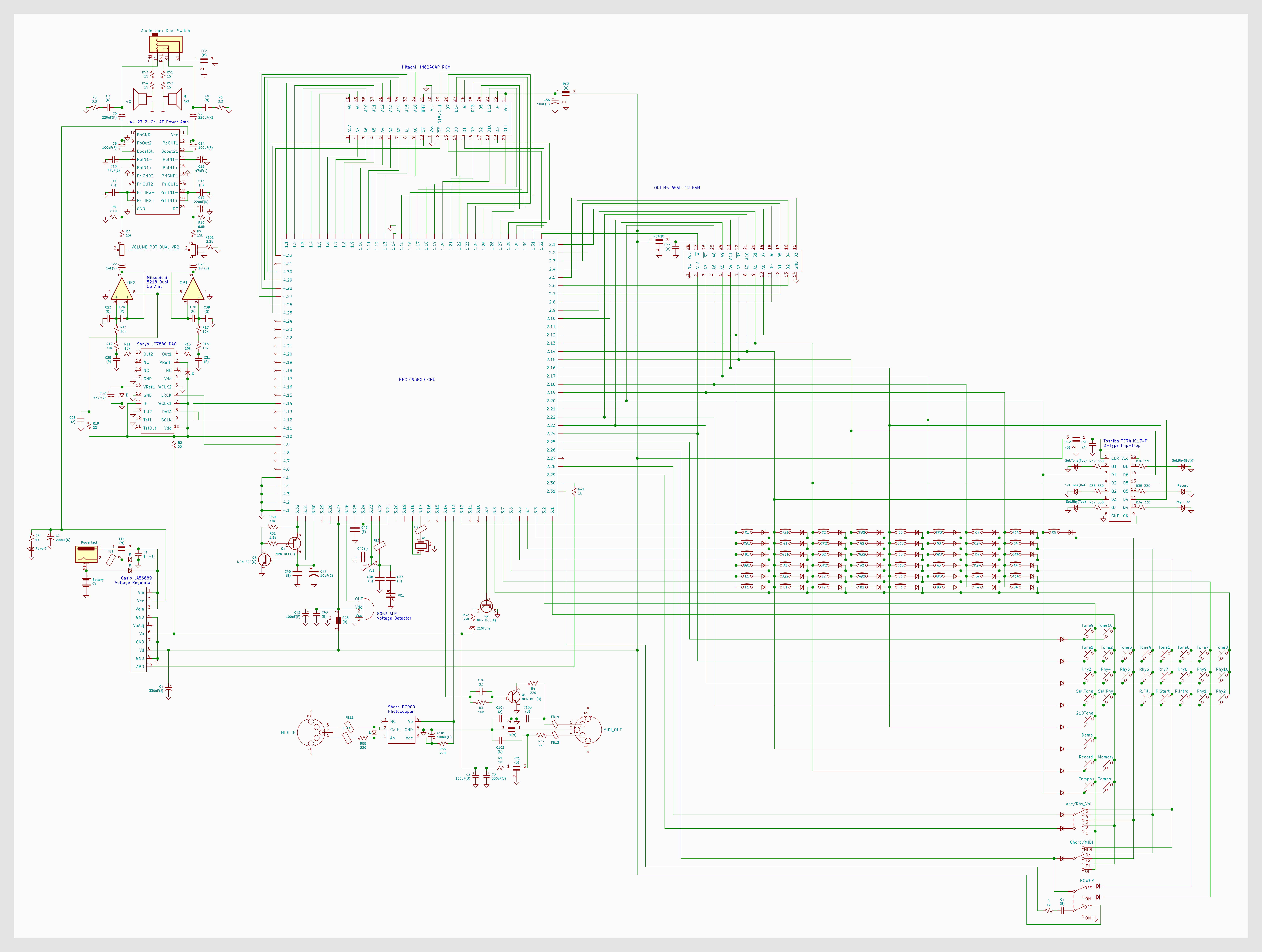
This page covers how a stock (unmodded) MT-240 works. Knowing how the system works as intended makes it a lot easier to bend. Most of it comes from a full schematic I reverse-engineered from the board.
Summary
The power circuit feeds the chips, and a crystal clocks the CPU. The CPU scans the keyboard and button matrices for presses, while an LC circuit sets the base pitch. When a key is played, the CPU runs programs from the ROM to compute digital samples, and the DAC turns them into sound for the amplifiers. A few parts are still mysteries.
Power-On
Power from the AC adapter or batteries goes to a voltage regulator, which supplies a steady voltage to the rest of the chips. The 'POWER' switch doesn't cut the supply directly; it signals the CPU to turn on. A voltage detector watches the supply and holds the CPU in reset whenever the voltage is too low, so it starts cleanly and doesn't crash as the batteries die.
![[Power section of the board]](../img/build/placeholder.jpg)
Xtal Clock
A crystal oscillator sets the CPU's clock speed, which determines how fast it runs its programs. Changing the clock (a classic circuit bend) shifts everything timed by the CPU: timbre, the delay between parts of a sample, tremolo, vibrato, and the timing between the left and right channels.
Keyboard & Button Matrices
The keys are wired in a grid of rows and columns, so each key sits at one row/column crossing. The CPU powers the rows one at a time and reads the columns. When a key is pressed, it connects its row and column, and the CPU knows which note to play. The 'Tone' and 'Rhythm' buttons work the same way in a separate matrix.
Both matrices have empty spots: inputs the CPU responds to but that were never wired to a key or button. These hidden functions include an extra upper octave, 10 more 'Tone' presets, and a sustain pedal feature.
LC Circuit
A small oscillator built from capacitors and inductors sets the pitch of the notes. I think the CPU divides this base frequency down to get each note, with each half-step 21/12 higher than the last. That's why the whole keyboard goes sharp or flat together when the oscillator is retuned.
ROM and CPU
When a key is pressed, the CPU and ROM start a loop that goes roughly like this: (1) the CPU puts an address on the 18 address lines (A0–A17); (2) the ROM sends the data stored at that address back on the 16 data lines; (3) the CPU acts on it. This loop repeats constantly, running the programs and reading the values (waveforms, envelopes, durations, and so on for the selected 'TONE'). The result is a stream of digital sample values for the DAC.
Normally this is tightly controlled: the ROM's contents were written to run in a precise order. Circuit-bending the ROM means cross-connecting address and data lines so the CPU reads the wrong addresses or gets altered data. The programs then run in ways nobody intended, which produces some very bizarre sounds. This is the heart of the circuit-bent MT-240.
DAC, Amplification, Speakers
The DAC turns the CPU's digital samples into an analog signal, which starts out very quiet. An op-amp stage buffers it and raises it a little, so the volume slider has a usable range. A power amplifier IC then boosts it enough to drive the speakers.
The headphone jack has a built-in switch. Plugging something in disconnects the speakers and sends the signal to the jack instead.
Misc. & Mysteries
The CPU also handles MIDI. The MIDI input goes through an optocoupler (photocoupler), which keeps the MT-240 electrically isolated from the other device, as the MIDI standard requires. The CPU switches the LEDs through a flip-flop, and the RAM can record a short sequence of key presses. The remaining mystery: a group of transistors whose job I haven't figured out.